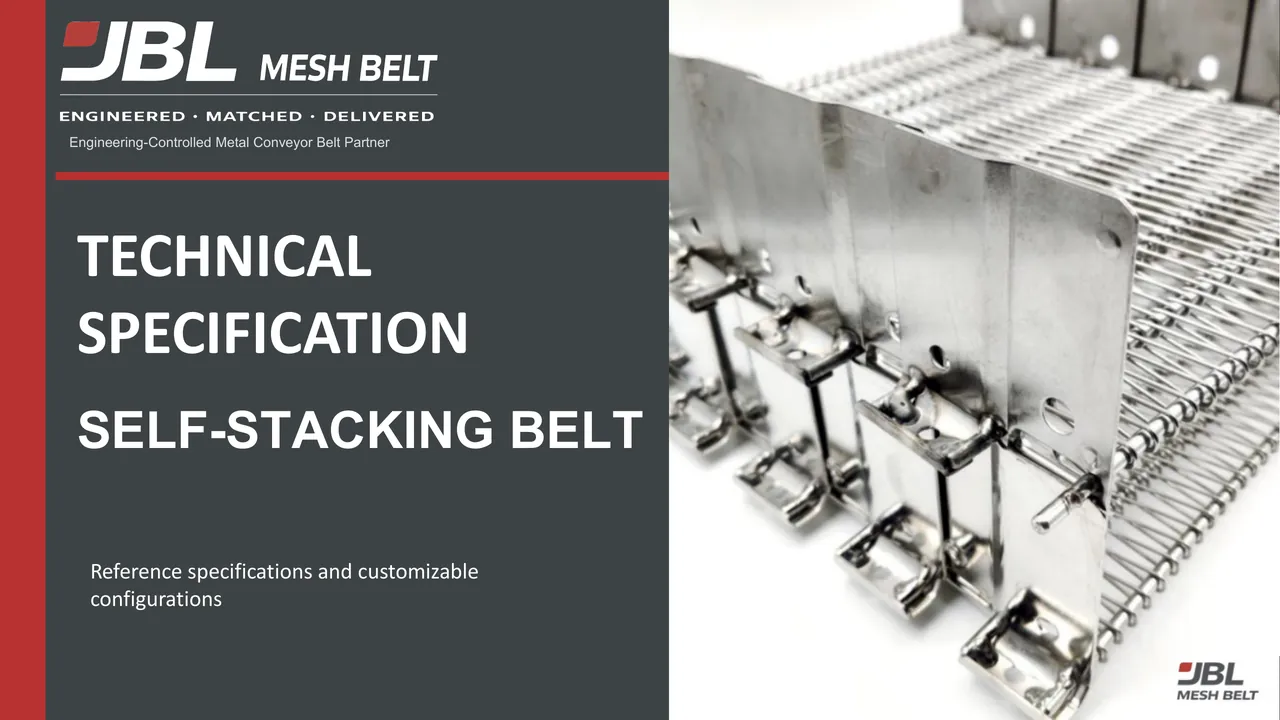
Self-Stacking Belt Technical Specification
12 pages · flip through online · tap the right half for the next page
What you will find in this specification
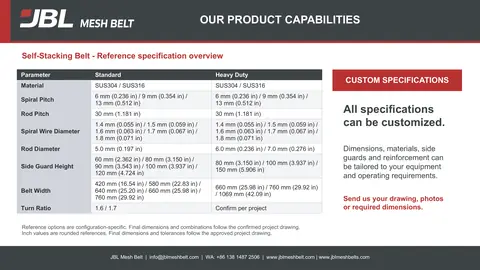 Standard vs heavy dutyBoth styles compared on one page.Open page 2 →
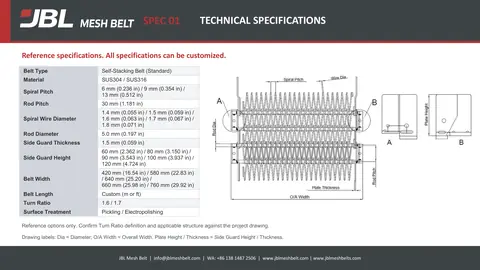 Full parameter tablesOne page for each style.Open page 5 →
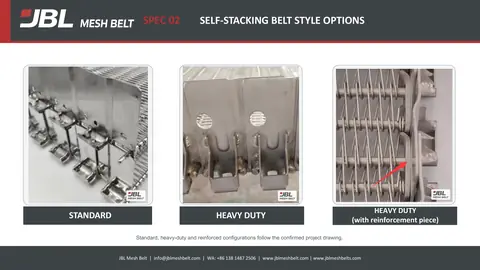 Three belt stylesStandard, heavy duty, and heavy duty with reinforcement piece.Open page 7 →
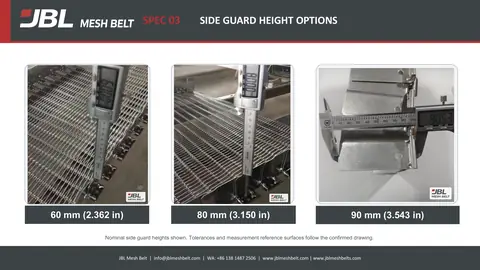 Side guard heights60, 80, 90, 100, 120 and 150 mm, with photos.Open page 8 →
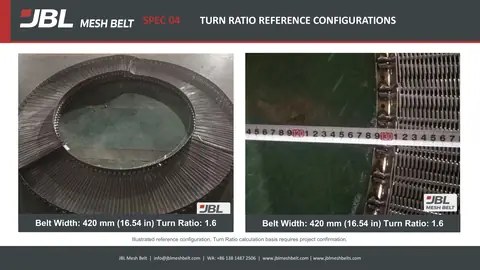 Turn ratio reference configurationsIllustrated examples; the calculation basis is confirmed per project.Open page 10 →
About this document
This 12-page technical specification describes the JBL Mesh Belt Self-Stacking Belt for stacking conveyors and space-saving conveying lines.
It compares the standard and heavy-duty styles side by side — spiral and rod pitch, wire and rod diameter, side guard thickness and height, belt width and an optional reinforcement piece — and shows reference turn-ratio configurations.
Tier engagement, side guard height and the turn ratio basis must match your equipment; final dimensions follow the confirmed project drawing.
Self-Stacking Belt reference specifications
| Parameter | Standard | Heavy duty |
|---|---|---|
| Material | SUS304 / SUS316 | SUS304 / SUS316 |
| Spiral pitch | 6 / 9 / 13 mm | 6 / 9 / 13 mm |
| Rod pitch | 30 mm | 30 mm |
| Spiral wire diameter | 1.4 / 1.5 / 1.6 / 1.7 / 1.8 mm | 1.4 / 1.5 / 1.6 / 1.7 / 1.8 mm |
| Rod diameter | 5.0 mm | 6.0 / 7.0 mm |
| Side guard thickness | 1.5 mm | 1.5 mm |
| Side guard height | 60 / 80 / 90 / 100 / 120 mm | 80 / 100 / 150 mm |
| Reinforcement piece | — | 4 × 15 mm where specified |
| Belt width | 420 / 580 / 640 / 660 / 760 mm | 660 / 760 / 1069 mm |
| Belt length | Custom (m or ft) | Custom (m or ft) |
| Surface treatment | Pickling / electropolishing | Pickling / electropolishing |
| Turn ratio | Confirmed per project | Confirmed per project |
Reference options from the 2026-10-02 public specification, pages 2, 5 and 6; options are style-specific. Final dimensions and combinations follow the confirmed project drawing. See page 5 →
Questions this document answers
+What is the difference between the standard and heavy-duty self-stacking belt?
In the specification the heavy-duty style uses a 6.0 or 7.0 mm rod instead of 5.0 mm, offers side guard heights of 80, 100 and 150 mm, widths up to 1069 mm and an optional 4 × 15 mm reinforcement piece (pages 2, 5–6).
+Which side guard heights are shown?
60, 80, 90, 100, 120 and 150 mm nominal heights (pages 8–9). The side guard sets the tier height, so it is measured from the same reference surface as your drawing.
+What rod and spiral pitches are listed?
A 30 mm rod pitch and spiral pitches of 6, 9 or 13 mm for both styles (page 5).
+Does the specification state the turn ratio?
Pages 10–11 show illustrated reference configurations. The turn ratio calculation basis is confirmed for each project before any value is fixed.
+What should I send for a replacement review?
Photos of the stacking area and side plates, a sample or drawing, and the running direction. Email info@jblmeshbelt.com or WhatsApp +86 138 1487 2506 (page 12).
Looking at a self-stacking conveyor for a space-saving layout?
JBL Mesh Belt's Self-Stacking Belt supports stacked conveying arrangements for food processing and industrial applications.
The belt must support your product and engage correctly between tiers. Width alone does not tell you whether a replacement will fit.
We review the belt structure, tier engagement, equipment geometry and operating requirements with you before specification confirmation.
Dimensions, materials and structural configurations can be customized according to your project. Final details follow the confirmed drawing.
Send us photos of your existing belt, equipment drawings and information about the product being conveyed.
For new equipment or replacement projects, JBL Mesh Belt helps you assess the configuration and align the specifications before ordering, with clear records to support future repeat purchases.