Which Metal Conveyor Belt Fits Your Line? A Selection Guide by Machine and Product
Short answer
Start from the machine, then the product. Drum-driven spirals use spiral or side-driven belts; self-stacking freezers use self-stacking belts; tunnels, cookers and washers use eye link or flat wire belts; ovens and fryers use eye link, chain-driven, Z-type, balanced weave or biscuit belts. Replacing a belt? Match the installed one first.
01Start from your machine
The machine decides the belt family. The product then decides the surface: how open, how flat and how close the support must be.
| Your machine or line | Usually | Checked first |
|---|---|---|
| Spiral freezer or cooler, drum-driven | Spiral freezer belt | Drum diameter, turn ratio, running direction |
| Spiral driven by sprockets on the belt edge | Side-driven belt | Rod pitch, turn ratio, sprockets |
| Self-stacking spiral freezer | Self-stacking belt | CW / CCW, tier height, side plates |
| IQF tunnel freezer, cooker, pasteurizer | Eye link belt | Eye-link pitch, rod pitch, edge, sprockets |
| Washer, drainer, cooler, onboard freezer | Flat wire / honeycomb belt | Number of openings, strip size, edge |
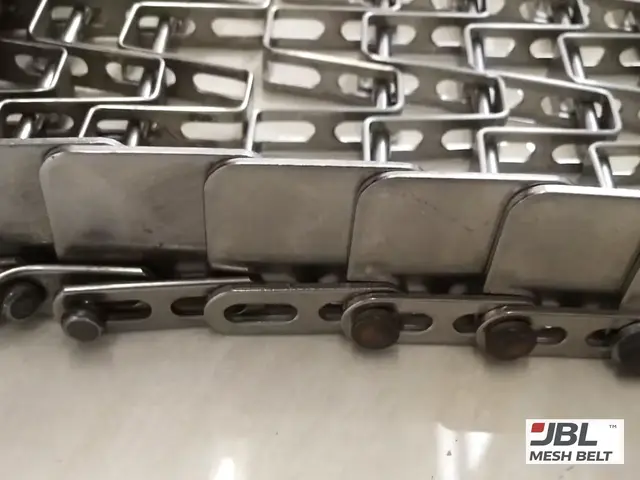
| Oven or steam tunnel with chain edges | Chain-driven belt | Chain model and pitch, rod pitch, edge |
| Fryer | Eye link, chain-driven or Z-type ladder belt | Oil temperature, product, material grade |
| Pizza oven or light product on an open belt | Z-type ladder belt | Odd number of spaces, edge loop, crimped edge |
| Baking, drying, small or soft products | Balanced weave belt | Sprocket or friction drive, wire hardness |
| Dense, strong woven surface | Compound weave belt | Rod arrangement on the sample or drawing |
| Biscuit and cracker ovens | Biscuit belt | Flatness, spiral and rod pitch, edge |
| Heavy parts, items that fall through mesh | Plate link belt | Plate pitch, chain pitch, load and drive |
02Choose it when — and when not
Each belt type has lines it suits and lines where another belt is usually the better start. The final choice is confirmed against your equipment.
| Belt | Choose it when | Not the first choice when |
|---|---|---|
| Spiral freezer belt | The belt turns around a driving drum in a spiral | The freezer is self-stacking, or the belt is driven only at the edge by sprockets |
| Self-stacking belt | Tiers stack on their own side plates, without rails | The spiral has a cage and rails to carry each tier |
| Side-driven belt | The spiral uses sprockets on the side links | The drum drives the belt by friction on the inside edge |
| Eye link belt | A long straight run needs strength and airflow | Very small pieces need a close, flat surface |
| Flat wire belt | Product must drain, cool or wash on a flat, open surface | Small pieces could fall through the openings |
| Chain-driven belt | The mesh is carried by roller chains on both edges | A simple, light conveyor runs on sprockets across the width |
| Z-type ladder belt | A light product runs on a simple, very open belt | Heavy loads, or products that need close support |
| Balanced weave belt | Small or soft products need closer support; baking or drying | The line needs the most open surface for draining |
| Compound weave belt | A dense, strong woven surface is needed | Airflow and drainage come first |
| Biscuit belt | A flat, dense surface carries dough through an oven | Wet product must drain |
| Plate link belt | Heavy or small parts need a solid or perforated plate surface | Airflow through the belt is needed |
03Common selection mistakes
Most wrong belts look right in a photo. These are the mismatches we check before quoting.
- ✓A spiral belt and a self-stacking belt can look alike from above — side plates and tier height tell them apart.
- ✓Running direction: a self-stacking belt built CW will not stack on a CCW freezer.
- ✓Z-type ladder belts need an odd number of spaces to track straight.
- ✓Chain-driven belts: the chain pitch must match the sprockets, not only the mesh.
- ✓Flat wire belts: the number of openings across the width must match the old belt.
- ✓Balanced weave belts: sprocket-driven belts use hard wire; friction-driven belts use softer wire by width.
- ✓Copying a worn belt copies its wear — elongated pitch is checked against the drawing or an unworn section.
04Replacing a belt? Match what is installed first
On an existing line the installed belt is the reference. Changing belt type is a design change and is reviewed with the drive and the product before anything is promised.
- ✓Photos of the belt top, edge and underside, with a ruler or caliper in the picture
- ✓Pitch over 10 pitches, wire and rod diameter
- ✓Drum diameter, turn ratio and direction for spirals
- ✓Sprocket tooth count, bore and wear
- ✓A short section of the old belt, if you can send one
05Real projects by line
Each project below started from the customer's sample, drawing or photos. Open a case to see the readings and photos.
| Line | Belt | Project |
|---|---|---|
| Meat freezing, self-stacking freezer | Self-stacking belt | Brazil, 2025 |
| OEM replacement, self-stacking freezer | Self-stacking belt | United Kingdom, 2026 |
| Spiral belt replacement | Spiral belt | Malaysia, 2026 |
| Bakery spiral cooling | Spiral belt | Australia, 2023–2024 |
| Shrimp IQF tunnel | Eye link belt | Spain, 2026 |
| Onboard fish freezing | Flat wire belt | USA, 2024 |
| Can washing line | Flat wire belt, 316L | Australia, 2022 |
| Steam oven tunnel | Chain-driven belt, 316 | Australia, 2023 |
| Potato chip frying line | Z-type ladder belt | Libya, 2025 |
| Pizza ovens | Z-type ladder belt | Australia, 2025 |
Want this checked on your belt?
Send photos with a tape in the picture, a drawing or an old belt section — usually a reply within 8 hours.
Belts in this guide
Related guides
- Case: self-stacking belt, meat freezing, Brazil →
- Case: eye link belt, shrimp IQF tunnel, Spain →
- Case: 316L flat wire belt, can washing, Australia →
- Case: chain-driven belt, steam oven, Australia →
- Case: Z-type ladder belt, frying line, Libya →
- IQF tunnel freezer belt guide →
- Flat wire vs balanced weave →
- How to photograph and measure an old belt →
- Filter belts by process, industry and machine →
Questions Buyers Ask
Q1How do I know which belt I have?
Send photos of the top, edge and underside with a ruler or caliper in the picture. The edge, the mesh pattern and the drive usually identify the belt type; we confirm it and list what is still missing.
Q2What is the difference between a spiral belt and a self-stacking belt?
A spiral belt is carried tier by tier on the freezer's rails and turned by a drum. A self-stacking belt carries the tier above on its own side plates, so it has no rails; direction and tier height must match the freezer.
Q3Can I change to a different belt type on an existing line?
Sometimes, but it is a design change. Drive, sprockets, product support and cleaning are reviewed first; for a like-for-like replacement the installed belt stays the reference.
Q4SUS304 or SUS316?
It depends on salt, acids, cleaning chemicals and temperature on your line. The grade is confirmed per project, and a third-party material test report can be arranged on request.
Q5Do you supply the sprockets too?
Yes. Sprockets are matched to the belt pitch and checked with the belt before shipment.
Q6How fast do you reply?
Usually within 8 hours. Lead time, payment and warranty are confirmed in writing in your quotation.